


Environmental justice seeks rep
in PUP student body; advocates push for ‘mobilized eco-awareness’
WORDS Danielle Barredo, Glen Kerby Dalumpines, Khengie Hallig, Graziella Mateo, Randolf Maala-Resueño, and Yesha Ryn Santos
MANILA CITY — Six years left before the repercussions of climate change become irreversible giving birth to various environmental organizations. The Polytechnic University of the Philippines (PUP), known for its firm stance against social issues, has joined the movement through environmental-related groups established inside the institution.
However, despite the existence of the environmental organizations within the university, there are still no groundbreaking changes made despite the efforts to conduct seminars to educate the students hoping that equipping them with knowledge would make them vehicles for mitigating environmental problems.
Now more than ever, the university and its student body are in a crunch against environmental awareness. When fifty students around the campus were asked to rank themselves from “Fully Aware” to “Fully Not Aware” about environmental justice, only six percent were fully aware, 42 percent were aware, a staggering 54 percent were neither aware nor unaware, while the remaining eight percent were “not aware.”
On the other hand, when asked to what extent they would act upon these environmental issues, ten percent said they would participate “to a great extent,” 28 percent were “to a sufficient extent,” almost half of them said “to some extent,” and 14 percent said that their participation level bares “to a lesser extent.”
The team also asked the students whether their courses provide environment-based subjects besides topics tackled in their National Service Training Program (NSTP) and other general education (GEED) subjects. Only 9 out of 50 students said their courses provided studies on the matter. Coincidentally, most of the 9 students are from science-related fields including the Bachelor of Science (BS) in Biology, BS in Industrial Engineering, and BS in Transport Management.
Findings revealed that their ratings on awareness are relatively high compared to how they rate themselves in terms of their actions taken to fight climate change. This shows a well-informed student body but lacks the initiative to call for action or even abide by basic practices that will help the climate change campaign.
When presented with this result, the team talked with advocates of all shapes inside the university. From student leaders to environment-based institutions, they, too, have raised concerns.
Sci-tech for the People, by the People

John Alexis Cabolis is a 4th-year BS statistics student. He is the current Chairperson of Agham Youth PUP (AY-PUP), a student organization that aims to serve the Filipino people through science and technology.
Cabolis said in an interview about the group’s shift to its environmental-justice roots. The nationwide science advocates boast its “Science and Technology for the People” or #SNT4P program as a core mass integration enterprise. It focuses on five functions including environment, food security, scientific and mass culture, public utility, and national industrialization.
Cabolis added that these issues coincide with environmental justice concerns by integrating the values of different sectoral problems toward environmental causes including a genuine agrarian reform, protection of ancestral domains, and lobbying for House Bill 8170 or the “Environmental Defense Act of 2020” which would safeguard environmental and climate change advocates.

The sci-tech group also emphasized the significant prospect of a nationally industrialized country as it leads to genuine control of our natural resources instead of foreign investments.
“Aside from isabuhay ang mga pinaniniwalaan, isa talaga sa pinaka epektibo pa rin ang pagsali sa mga mass organizations. Kasi mas mapapalakas mo [ang iyong kamalayan sa] kung anong nangyayari sa lipunan, ano ‘yung problema sa lipunan na hindi kayang maituro ng paaralan,” Cabolis urged the studentry to continue the fight for environmental justice.
(Aside from practicing what you preach, one of the effective ways is joining organizations. Because you strengthen your awareness in society, the problems in society that aren’t taught in schools.)

On the other hand, the lack of participation may also be rooted in the fact that most colleges and programs not concerned with the sciences pay less attention to the environmental cause. Cabolis added that most AY-PUP members were from the College of Sciences (CS), College of Engineering (CE), Institute of Technology (ITECH), and College of Computer and Information Sciences (CCIS), which are conventionally science-centric institutions.
Project ISKO-LASTIK
John Reggie “JR” Reyes is a 2nd-year political science student. He is a councilor of the Sentral na Konseho ng mga Mag-aaral (SKM) and its Holistic Wellness and the Environment Committee Head.
Even as a sophomore, Reyes is well involved in the affairs of environmental issues within and outside the campus. Reyes’ committee in the SKM focuses on the overall well-being of students, in particular on projects that target and focus on the campus’ environmental beautification.

Currently, SKM is devising a project called "Iskolastik." It is an action plan to limit and/or eliminate the use of single-use plastics around the campus.
Single-use plastics are objects that are made from fossil fuel-based chemicals and are designed to be disposed of immediately. It also contains substances like endocrine disruptors that are harmful and may cause birth defects, cancer, and disruption of the immune system.
Project Iskolastik aims to lessen the university’s usage of it.

“Pwede kasi siyang total eviction ng single-use plastic, or pwede tayo magkaroon ng araw na hindi tayo gagamit ng mga ganitong uri ng produkto. Isa ‘yan sa anggulo na tinitingnan natin,” Reyes suggested.
(It can be a total eviction of single-use plastic or we can have a day where we will not use any product made of it. It is one of the angles we are looking at.)
However, there are still many factors that should be taken into consideration before implementing this plan. He deeply understands that this initiative requires the cooperation of students and vendors inside the school.
“It is not fair if SKM only implements what the council thinks of; it’s better when ideas come from students and the people affected,” he added.
As a result, SKM is still investigating and researching this proposal and is open to any recommendations and concerns from students.
Reyes also reiterates the importance of having progressive and concrete climate action as we approach the 2030 deadline when the effects of global warming become inevitable.
Environmental justice in the eyes of a journalist
Former College of Communication Student Council (COC SC) Councilor John Carlo Caoile has been passionate about the environment for as long as he can remember. Even in his busy graduating year as a journalism student, Caoile still finds time for his environmental advocacies.
As a former member of Sandigan para sa Mag-aaral at Sambayanan PUP (SAMASA-PUP), he was able to expose himself to crowds of people who have the same advocacies he has for the environment. Much like Reyes, who emphasizes the need for more mobilization, Caoile also feels that students lack initiative regarding environmental justice and conservation.
“Kumbaga as college students, may awareness naman na tayo pagdating du’n sa mga environmental issues like sabi kanina. May awareness sila pero ‘yung call to action, wala.”
(As college students, we have awareness regarding environmental issues as mentioned earlier. We have the awareness but we lack a call to action.)
As a member of the Caloocan Young Leaders’ Initiative environmental cluster, Caoile has firsthand experience with environmental projects that mostly deal with recycling, specifically upcycling what is considered already garbage into something more useful for people. Their main project includes upcycling old campaign tarpaulin material into tote bags that they give away.


He also encourages students to be a part of change for the environment and take initiative within their communities. Given that PUP students are already aware and exposed to the needs of the environment, he states that we then must bring these issues down to our communities so we can help other people be enlightened as well.
He goes on to say that we only have one Earth to live in. As student journalists, it is down to us to uplift the voices of each other and fight for our advocacies beyond our echo chamber.
“As journalists, role natin ay hindi lang mag-ulat, mas goal din natin ay magmulat.”
(As journalists, our role is not only to report but also to open the eyes of others.)
Hand in Hand: Joining forces for environmental justice
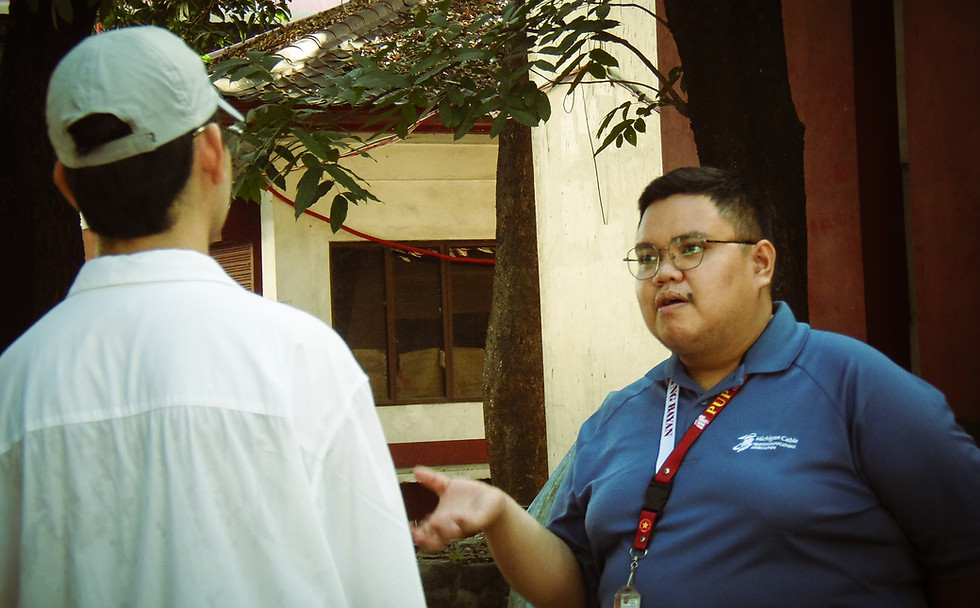
With intentions to better sustain the university’s environmental pursuit, the student body also merged plans with the university administration. In an interview with Jimmy Fernando, Chief of PUP’s Center for Environmental Studies (CES), he said that the administration, alongside PUPian environmental advocates, collaborate in planning and executing projects for the environment.


AY-PUP, together with Sibol ng Agham at Teknolohiya (SIBAT), 350 Pilipinas, and Adamson University, are proposed linkages which the administrators collaborated with past projects, including discussions, research, seminars, and forums together with different student organizations.
“Yung ating mga ITECH student, klaro na sa kanila ‘yun, malinaw na sa kanila na ‘yung kanilang mga prototypes ay dapat naglilingkod sa kalikasan–sa tao at kalikasan," the CES Chief said, pointing up the ITECH’s project with 350 Pilipinas about the solar charging station.
(With our ITECH students, it’s clear to them that their prototypes should serve the environment and the people.)

Aside from these project initiatives in collaboration with the PUP administration and various organizations, he also shared the commemorative dates for the annual events, such as Earth Day and PUP Environmental Consciousness Week. He also announced one of their upcoming projects called the Renewable Energy Summit, in collaboration with AY-PUP.
During the interview he shows paintings of students that symbolize advocacy for the environment, sharing their initiative through the artworks of their students.


Road to a carbon-free PUP; goals for mobilization
The goal to mobilize human resources is another challenge to the institution that Fernando emphasized during the interview.
The CES Chief pointed out their initiative regarding the environmental issue within the university systems. According to him, this initiative should be applied not only to students but to professors and faculty as well by doing waste segregation and recycling.
Proper waste segregation was an overall initiative of PUP as an institution. The administration, together with the partnership of its linkages, also plans further projects to pave the way for a more eco-friendly environment in PUP. The institution itself has its own Sustainability Policy about "Green Talks."
In this regard, Fernando also revealed ongoing research together with 350 Pilipinas about bike mobility on campus, planning to erect bike racks along university lanes.
In talks about the PUP administration's priorities in terms of environmental advocacy, the CES Chief said that this is where their role as an academy in fighting for climate justice relies.
“Ito yung pwede nating magawa bilang akademya. Ang hamon sa akademya, sa mga school, syempre hindi lang ‘yung propagation n’ung teorya at concept ng SDG (Sustainable Development Goals). Totoong pagdating sa akademya, lugar ito ng diskurso, debate, discourse, pero nasaan yung action? Yung simpleng pag-padyak ng bisikleta ay isang action para sa environmental justice, diba?”
(This is what we can do as academics. The challenge in the academe, in schools, is not just the propagation of the theory and concept of SDG. Truly when it comes to academia, it is a place of discourse and debate, but where is the action? It’s as simple as the use of bicycles for action on environmental justice, isn’t it?)
He added that aside from campaigns, PUP also reflects its environmental advocacies through its offered programs and courses that aim to heighten the awareness and consciousness of the students.
“‘Yung mga actual [..] actions na makakatulong talaga–papunta talaga sa pagtugon sa commitment ng university sa SDG, commitment sa tao, at commitment sa kalikasan.”
(The actual [..] actions that can truly help—always point to the call of commitment of the university to SDG, commitment to people, and commitment to the environment.)
‘Mobilized eco-awareness’ at the forefront
In empowering the call for action, PUP encourages its students to have consciousness when it comes to environmental issues.
Cabolis encourages his fellow PUPians to become responsible and active students. He prompts everyone to join discussions and mobilizations within and outside the university, even those students who are not members of any organization. Through that, they can understand how serious the problem is, which hopefully motivates them to take action.
Subsequently, SKM will conduct a general assembly with its committees so that they can come up with a unified plan before organizing a town hall consultation among the departments of the university. “Tapos na tayo sa awareness. (We are done with awareness.) We need to take concrete action towards this ongoing problem,” Reyes pointed out.
Reyes encourages students to utilize reusable materials and avoid using single-use plastic such as straws, utensils, and plastic bags. He also urges everyone to bring their tumbler, as it can reduce the use of plastic cups and bottles. Yet he also empathizes with those students who do not have the luxury of buying their own.
Moreover, Caoile emphasizes how our planet is the only one we live in and we need to preserve and protect it. Its resources are limited and are even alarmingly dwindling in time due to human consumption. More than just reporting news at face value, as journalists, the truth of the story lies in our hands. We should always dig deeper than the surface and uncover what lies beyond just the objective facts, he adds.
Finally, Chief Fernando left a word to different sectors of the institution. His message to admins: to minimize the use of plastics; to students: to raise their consciousness; for the future: embrace the Earth and fight for the environment.
As we navigate student awareness and participation in environmental causes, it is now in the hands of the media to put forth the scale of environmental justice and advocacy within campus grounds. Focusing the lens on selecting stories of truth and concern for the Earth should be highlighted as far as actions are considered and implemented. The truth is that environmental activism in the university only reaches a portion of the supposed audience. Nonetheless, our student advocates are willing to be the stepping stone for change–it’s just a matter of self-vindication to set our ‘green’ foot forward.